Comparing ranking functions in BigQuery

Senior Data Engineer • Contractor / Freelancer • GCP & AWS Certified
Search for a command to run...

Senior Data Engineer • Contractor / Freelancer • GCP & AWS Certified
No comments yet. Be the first to comment.
A focused guide to window functions in BigQuery — cumulative sums, rolling averages, ranking functions, named windows, RANGE frames, and more.
What function do you use to explicitly de-duplicate in BigQuery?I normally use ROW_NUMBER(), but I've recently encountered a really interesting blog post suggesting ARRAY_AGG might be more performant for the task. The explanation given is that the OR...
Here's a useful Dataform concept: pre_operations and post_operations. As the name implies, these represent a set of actions that run before and after the main operation (table, view, or SQL operations

BigQuery has always been a SQL engine for tabular data. Object tables add an interesting twist to that. Instead of rows containing values, an object table gives you one row per file — pointing at da

Query your data lake with warehouse-grade security and performance — without moving a single file.

Ever run a heavy BigQuery SQL query, processed gigabytes of data — and then accidentally closed the tab or forgot to save the results? 😬 Don't re-run it. Your results are still there. BigQuery automa

You can use query parameters in BigQuery hashtag#SQL (now in the console as well!) — but how are they different from variables, and when should you use each? Both parameters and variables act as place

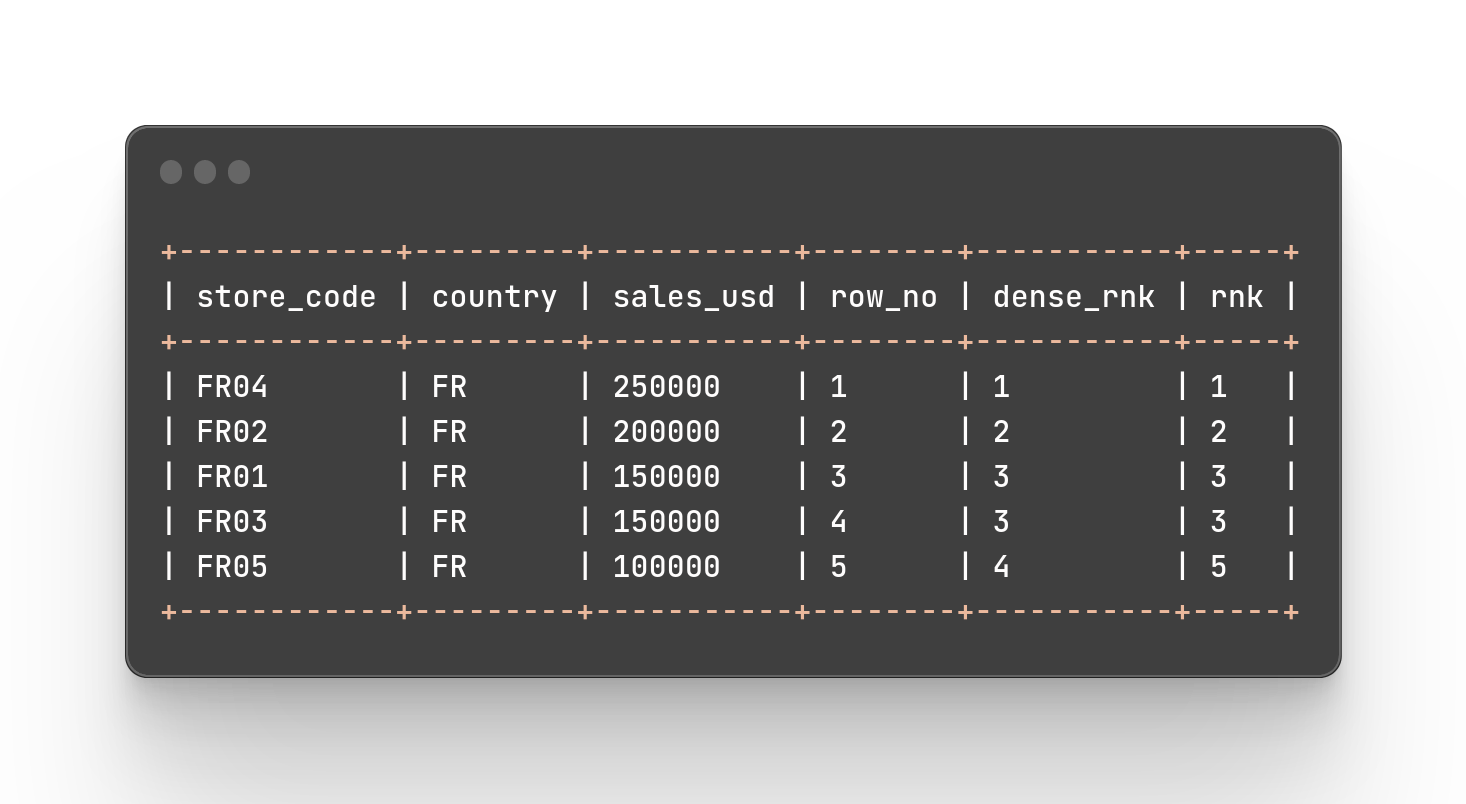
One of the most common sightings in SQL code is using ranking functions. It's simple but we must surely get it right. I use ROW_NUMBER very often for de-duplication, also used DENSE_RANK a couple of times - but I've never used RANK. So how are they different?
- ROW_NUMBER - sequential row number, regardless of equal values. If no order is provided, the results might be different every time you run it (aka non-deterministic): 1,2,3,4,5
- DENSE_RANK - also a sequential row number, but takes into account peer rows (with equal values). next rank is the immediate following: 1,2,2,3 (no gaps)
- RANK - also a sequential row number, takes into account rows with equal values, but next rank is incremented: 1,2,2,4 (with gaps)
See below for an example of how it all works.
SELECT
store_code,
country,
sales_usd,
ROW_NUMBER() OVER country_sales AS row_no,
DENSE_RANK() OVER country_sales AS dense_rnk,
RANK() OVER country_sales AS rnk
FROM input_data
WINDOW country_sales AS (PARTITION BY country ORDER BY sales_usd DESC)
Thanks for reading!
Found it useful? Subscribe to my Analytics newsletter at notjustsql.com.
Enjoyed this? Here are some related articles you might find useful: